Sees the smallest targets
Tuned to pick out low, slow, small drones against trees, buildings and terrain, where conventional surveillance radars lose them.

COUNTER-DRONE RADAR · BUILT IN INDIA
Maxmin builds high-performance electronically scanned radars small enough for a mast, a vehicle or a rooftop. One sensor covers drone defence, perimeter security and airspace monitoring.
SOLUTION
Small drones are the hardest targets in the sky. They fly low and slow, they're made of plastic and carbon fibre, and they hide among birds and ground clutter. Most radars were never built to see them. Ours was designed for them from the start.
Tuned to pick out low, slow, small drones against trees, buildings and terrain, where conventional surveillance radars lose them.
The beam is steered electronically, not by a rotating dish. It jumps anywhere in the sector in microseconds, so it can watch the whole sky and lock onto a threat at the same time.
The radar reads the signature of spinning rotor blades and separates drones from birds. Operators get fewer false alarms and can act faster.
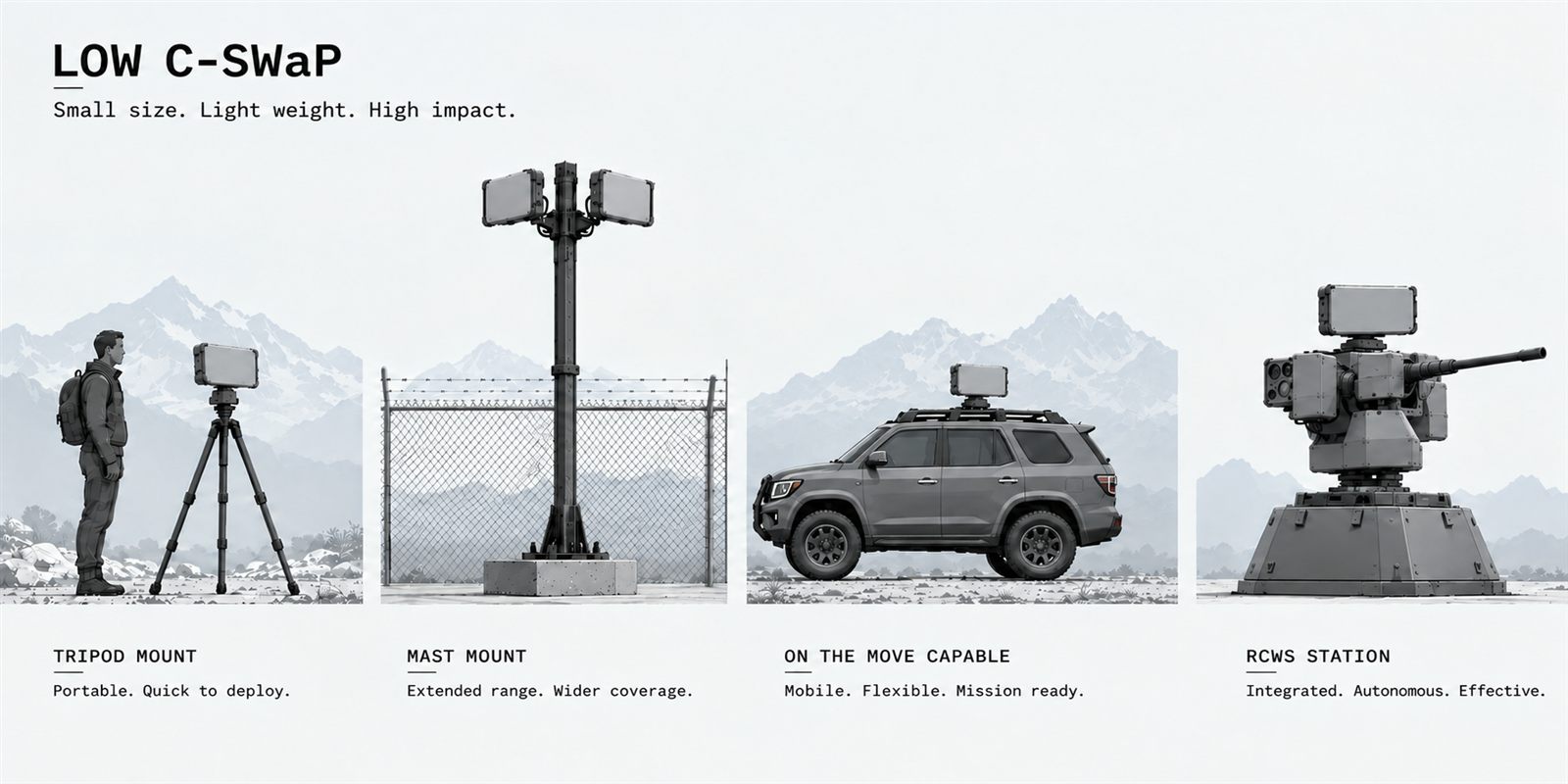
Low size, weight and power. Mount it on a tripod, a mast, a rooftop or a vehicle, and network several units for 360° coverage.
Designed and manufactured in India to match the performance of leading global systems, at a lower price and with a supply chain you can depend on.

HOW IT WORKS
The array concentrates its energy into a narrow beam and points it only where it needs to look. Its waveform spreads that energy thin, so it sees far without announcing itself.
An array of transmit/receive elements forms a narrow beam and points it electronically, so the radar can scan, dwell and track several targets at once.
Onboard processing pulls each target's range, speed and micro-motion out of the clutter and labels it: drone, bird or ground mover.
Confirmed tracks stream to your command-and-control system, cameras or interceptors in standard formats, ready for a decision.
No motors, no rotating parts, nothing to wear out in the field.
Low peak power, a tight beam, a spread waveform and agile frequency control leave enemy sensors very little to detect, track or jam.
Open-standards C2 integration through SAPIENT, ASTERIX and Cursor-on-Target, with development under way for India’s Akashteer and IACCS air-defence networks.